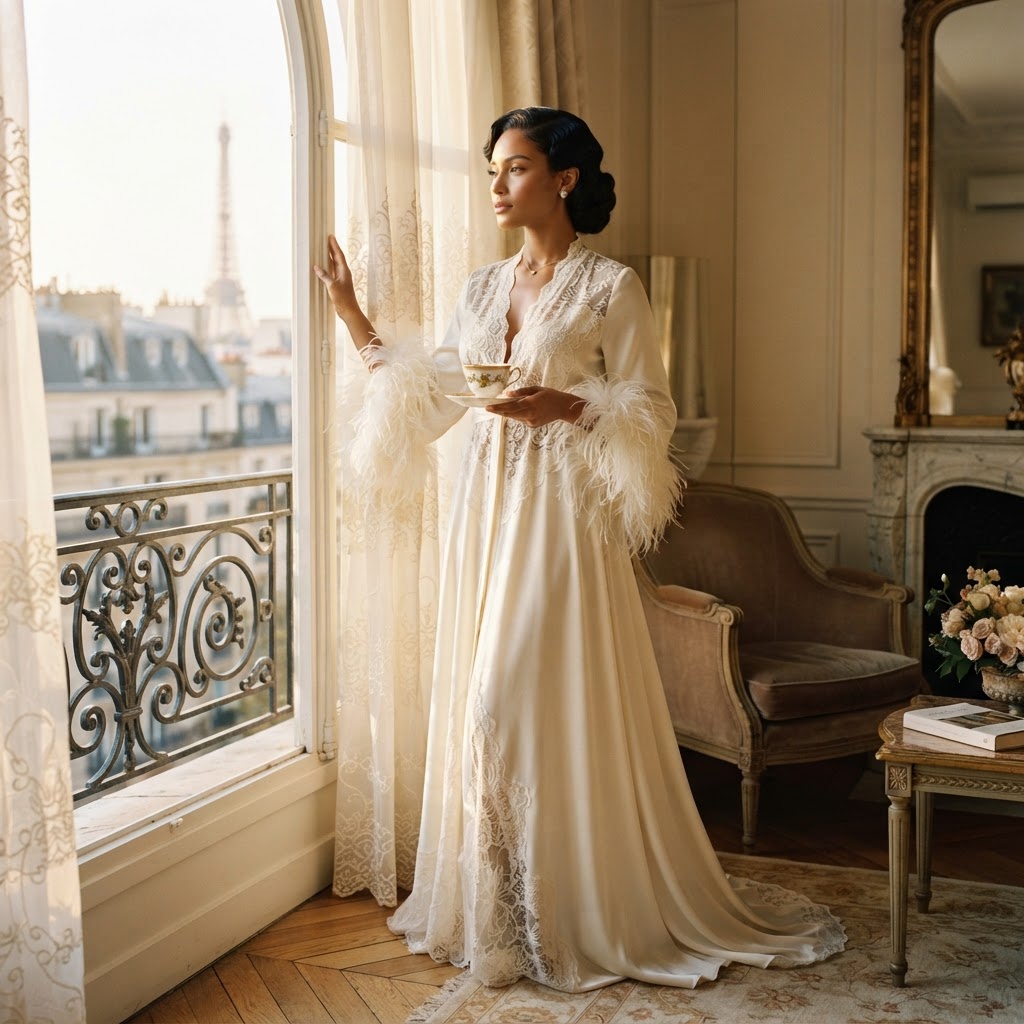
The peignoir is having a quiet renaissance. Not on runways, exactly — in real wardrobes, in the private hours of women who have decided that the first audience for their beauty is themselves.
Say the word slowly and you can hear what it is: peignoir, from the French peigner, to comb. It is the garment of the boudoir — a flowing robe, silk or lace or feather-trimmed, worn over a nightgown, historically the final layer a woman put on before presenting herself to the day. It is lingerie in the oldest and most intelligent sense: not an undergarment engineered to be seen, but a garment engineered for the woman inside it.
This is the distinction The Art of Womanhood returns to again and again, and it has never been clearer than here: a peignoir is not bought for anyone else. It is the rare piece of a woman's wardrobe that is entirely, unapologetically hers.
What a peignoir is — and is not
Lingerie as most of us now know it is designed for display: the lace set, the slip, the negligee — each cut to be looked at. A peignoir is designed for dwelling. It is the dressing gown of the boudoir, generous in its drape, unhurried in its closure, made for the slow morning, the long bath afterward, the cup of tea taken standing at the window.
Other lingerie asks who is looking. The peignoir asks only: how does she feel?
Why it is the truest luxury
The luxury of a peignoir is not simply its materials — real silk, French lace, hand-set seams — though those matter. Its luxury is intent. This is a garment with no professional function, no public function, no flattering-photograph function. It exists only to make the private hours feel chosen. In a culture where nearly every possession is expected to perform publicly, a beautiful thing worn for an audience of one may be the last honest luxury there is.
At The Art of Womanhood we define luxury as what is chosen with intention. The peignoir passes that test better than any handbag — it cannot be shown off without losing its meaning.
A small guide to choosing one
- Fabric first. Silk charmeuse or a fine cotton voile. If it cannot survive contact with bare skin, it is a costume.
- Length is a statement. A true peignoir falls long. The drama is in the drape, not the detail.
- Trim with a pedigree. Chantilly lace, a feather cuff, a self-tie of the same silk — ornament that comes from craft, not trend.
- Buy it for the woman in the mirror. If you are imagining who else will see it, start again.
The femininity of it
Here is the deeper reason The Art of Womanhood keeps a place for this garment. Femininity, as we practice it, is not performance; it is architecture — the inner standard made visible. A woman in a beautiful peignoir at seven in the morning, with no one watching, is keeping a standard no one enforced. That is character. That is ceremony. That is the art.
The return of the peignoir, finally, is the return of the woman who knows her own company is worth dressing for. Welcome back.
Continue Reading
Luxury · 7 min
The Psychology of a Beautiful Thing: Why What We Carry MattersLuxury is not simply what costs more. Luxury is what is chosen with intention.
Luxury · 9 min
The House of Dior: Timeless Femininity and the Art of CoutureFrom the 1947 New Look to today's ateliers — how the House of Dior turns structure, romance, and flowers into a way of being a woman.
Femininity · 8 min
Becoming Her: The Quiet Power of a Woman Who Knows HerselfWomanhood is not a performance to be perfected. It is a self to be known.