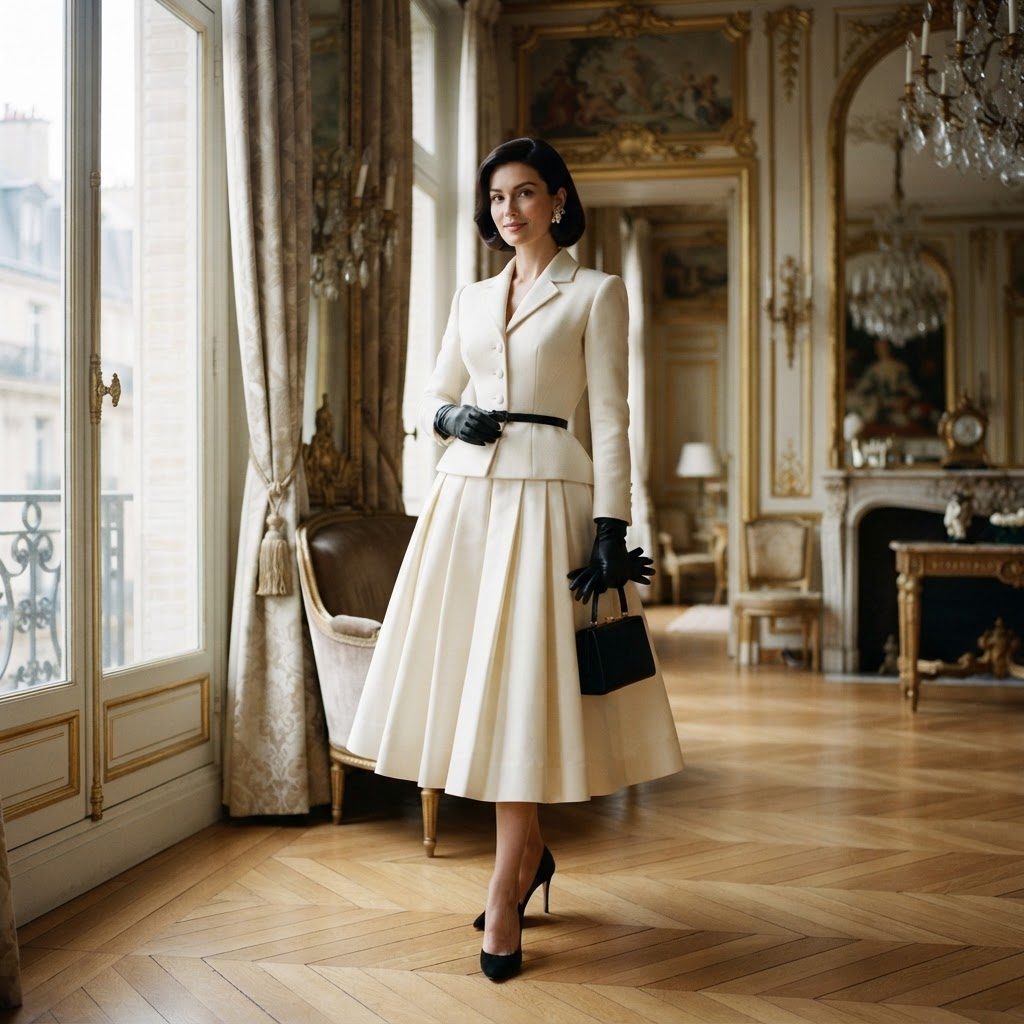
On February 12, 1947, a soft-spoken gardener's son from Normandy changed what it meant to get dressed. Christian Dior unveiled his debut collection — the "Corolle" line — in a Paris still gray from war: fabric was rationed, skirts were narrow, and femininity had been asked to stand down for a decade. Then the curtain rose on rounded shoulders, a nipped waist no wider than a hand span, and skirts that bloomed like inverted flowers over yards of pleated tulle.
Carmel Snow, the legendary editor of Harper's Bazaar, rose from her seat and delivered the sentence that would christen a century: "It's quite a revolution, dear Christian! Your dresses have such a new look!" The New Look — and with it, modern luxury as we know it — was born in a single afternoon.
What Dior restored was never simply fabric. It was joy. Structure. Romance. The radical idea that a woman's silhouette could be an argument for optimism — and that dressing beautifully was not frivolity, but a form of hope you could wear.
Structure, Romance, and Flowers
Every great house has a grammar, and Dior's is the most legible in fashion. The cinched waist. The sculpted shoulder. Pleated tulle skirts that hold air the way architecture holds light. The Bar jacket — that ivory miracle of 1947, hand-padded and hand-stitched, its lapels curved like petals — remains the most studied garment in fashion education nearly eight decades later.
And everywhere, flowers. Dior's first love was not couture but gardening; his childhood home in Granville, Les Rhumbs, sat above the sea in a riot of roses. He called flowers "the most graceful translation of femininity," and they appear throughout the house the way scripture appears in a cathedral. Miss Dior, his first fragrance, was named for his sister Catherine, a heroine of the French Resistance. Lily of the valley, stitched into hemlines for luck. Rose, corolla, tulip — the skirts themselves were grown from his garden.
What makes the House remarkable is that these codes never became a museum. After Monsieur Dior's sudden passing in 1957, each of his successors — Yves Saint Laurent, Marc Bohan, Gianfranco Ferré, John Galliano, Raf Simons, Maria Grazia Chiuri — translated the same grammar into a new decade's voice. The waist has softened; the flowers have traveled from embroidery to print to statement. But look at any Dior runway today and you can still see Granville in it. Living codes are how a house stays young for nearly eighty years.
The Women of the House
A house becomes a legend through the women who choose it, and Dior's roll call reads like a history of grace in public life.
Princess Diana in 1994, stepping out of the shadows and into history in black Dior-backed elegance — the photograph the world never forgot. Charlize Thorne, gold-lit and gliding for two decades as the face of J'adore. Natalie Portman bringing Miss Dior's romance to a new generation. Rihanna, who wears Dior with the ease of a woman who owns every room she enters. Anya Taylor-Joy, ethereal on every red carpet she graces for the house. And Jisoo, whose partnership turned millions of young women on the other side of the world into students of French elegance.
Wearing Dior does not make a woman powerful. It gives power a shape.
The red carpet truth is simple: structure at the shoulder, a waist held like a conviction, a skirt that moves like a held breath released. The world's most photographed women keep choosing it because it does what Dior promised in 1947 — it makes them not only more beautiful, but more themselves.
Savoir-Faire: The Power of Detail
Behind every Dior silhouette is a room most clients never see: the ateliers at 30 Avenue Montaigne, where the tailleur builds structure and the flou gives it flight. Here the petites mains — the master seamstresses whose titles take decades to earn — drape, cut, and bead entirely by hand.
A single couture gown may carry four hundred hours of work: silk petals cut one by one, thousands of beads sewn individually, a bodice fitted to one woman's exact posture. Nothing is rushed, because in this house patience is the most expensive material of all.
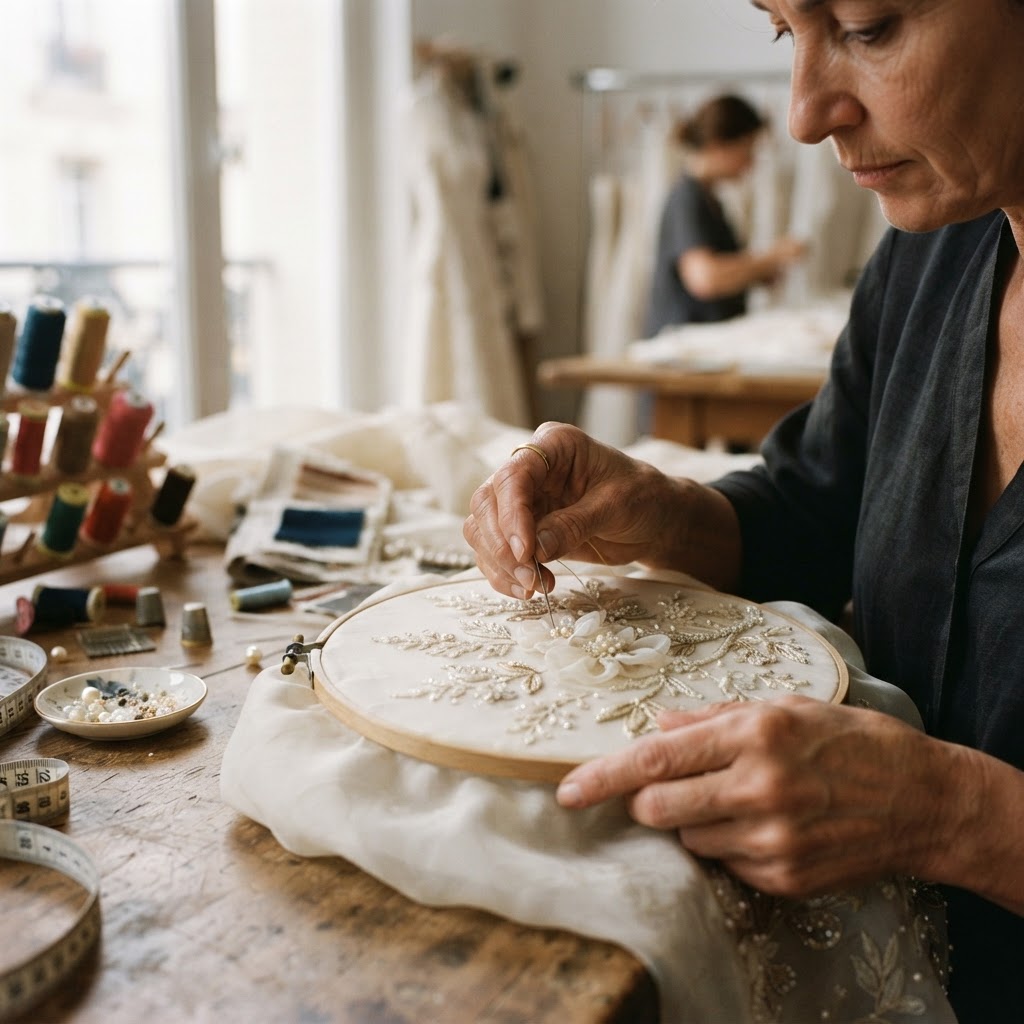
This is what haute couture actually means — not a price, but a practice: made by hand, made for one woman, made to be kept. And it teaches a principle every woman already knows in her bones: the details are not the details. They are the entire thing.
The Everyday Luxury Woman
Here is the quiet lesson the House of Dior offers a woman who will never walk a red carpet:
- Invest in structure. One beautifully tailored jacket — shoulders that fit, a waist that honors yours — outperforms a closet of almost-right things. Dior built a legend on one silhouette, not a hundred.
- Let romance into your structure. The woman the world finds magnetic is rarely all business or all bloom. Tailoring, softened. Flowers, disciplined. Wear both on purpose.
- Dress for the occasion of your own life. Dior's insight was never that women needed more clothes — it was that they deserved to feel like the main character of their own story. Whether that means silk on a Tuesday or linen on a Sunday is entirely up to you.
- Honor craft — in what you buy and how you build. The atelier's real luxury is attention. A woman who brings that same attention to her choices, her home, and her own becoming is practicing couture as a way of living.
Nearly eighty years on, the House of Dior still keeps the promise of that February afternoon: that fashion at its finest is not decoration — it is a declaration. A cinched waist as a line in the sand. A full skirt as a deep breath. A woman, fully herself, walking into the room.
Explore the House of Dior · Follow @dior
#TheLuxuryEdit
Continue Reading
Luxury · 6 min
Let's Talk Lingerie: The Return of the PeignoirThe Lace Set, The Teddy, The Negligee and The Peignoir — the quiet, radical act of dressing for an audience of one.
Luxury · 7 min
The Psychology of a Beautiful Thing: Why What We Carry MattersLuxury is not simply what costs more. Luxury is what is chosen with intention.
Femininity · 8 min
Becoming Her: The Quiet Power of a Woman Who Knows HerselfWomanhood is not a performance to be perfected. It is a self to be known.